Hospital Management Software in Nepal: A 2026 Buyer's Guide
How to choose hospital management software in Nepal in 2026 — IPD and OPD, pharmacy and lab, NPR billing, insurance and government schemes, and the questions that separate a real HMS from a demo.
Choosing hospital management software is a decision a hospital lives with for years. The wrong system shows beautifully in a demo and then falls apart the first time a real patient is admitted, transferred and discharged with an itemised bill behind them. This guide is written for hospital owners, administrators and IT leads in Nepal who are evaluating a hospital management system (HMS) in 2026, and it focuses on the things that actually decide whether the software survives contact with a live ward.
Start with the workflow, not the feature list
Every vendor's feature list looks the same on paper: patients, doctors, appointments, billing, reports. The difference is whether those features connect into one continuous workflow or sit as disconnected modules.
A real hospital episode looks like this:
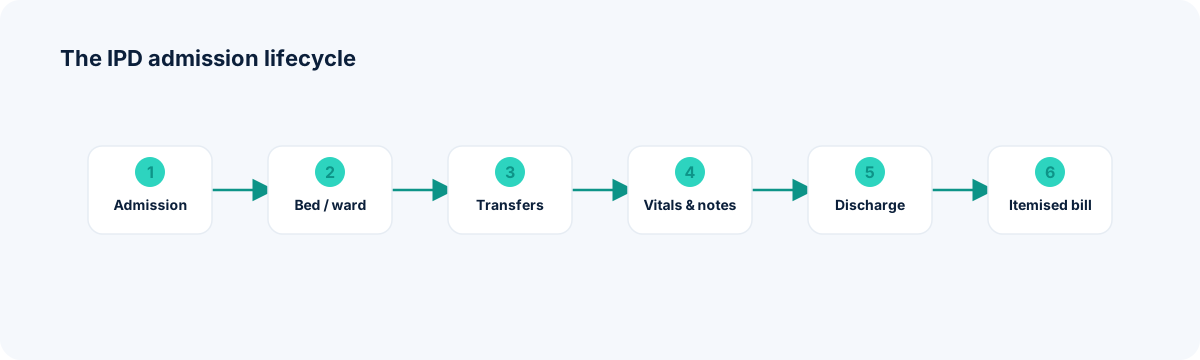
- A patient is admitted (IPD) or seen as an outpatient (OPD).
- An inpatient is allocated a ward, room and bed, and may be transferred between them.
- Nurses chart vitals and doctors write progress notes through the stay.
- The stay ends with a discharge summary.
- Every bed-day, procedure and consumable becomes a line on the bill, settled through payments.
If any of those steps lives in a spreadsheet or a second app, you do not have a hospital system — you have a patient register with billing bolted on.
IPD is the real test
Outpatient scheduling is easy; almost every product does it. Inpatient (IPD) administration is where hospital software is won or lost, because it is where the money, the clinical risk and the operational complexity concentrate.
Ask a prospective vendor to walk you through, live:
- Admitting a patient and allocating a specific bed in a specific ward.
- Showing a live bed-occupancy board — how many ICU beds are free right now.
- Transferring that patient to another bed and seeing the board update.
- Producing an itemised IPD bill with bed-days, procedures and consumables as separate lines.
- Discharging the patient and closing the episode.
Watch closely for one specific trap: how the system knows a bed is occupied. A bed marked "occupied" by a clerk is a second source of truth that drifts — a discharged patient can leave a bed stuck "occupied" forever. A well-built system derives occupancy from the live admission pointing at the bed, so the board never lies.
Billing has to speak Nepal
Billing is where imported software quietly fails in Nepal:
- Currency: bills, receipts and reports in NPR, not a hard-coded foreign currency.
- Payers: self-pay, insurance / TPA, corporate and government scheme / subsidy — a single bill often splits across them.
- Concessions: staff, senior-citizen, camp and goodwill discounts, with a reason recorded for audit.
- Bill types: IPD, OPD, emergency and day-care, each itemised differently — a five-field flat invoice cannot represent a hospital stay.
The modules that should already be connected
A hospital rarely runs in isolation. The strongest systems treat pharmacy, laboratory and diagnostics as part of the same platform, not separate purchases:
- The pharmacy tracks stock and expiry at the batch level, because that is where a drug actually expires.
- The lab moves an order from sample to result to report.
- Charges from both flow onto the same patient bill automatically.
If these are separate logins with separate databases, every hand-off is a place for a charge to go missing.
Questions that separate a real HMS from a demo
Take this list into every vendor meeting:
- Can you show me a live bed-occupancy board, not a screenshot?
- How does the system know a bed is free — who sets that, and can it disagree with reality?
- Show me an itemised IPD bill with bed-days and procedures as separate lines.
- Can one bill be split across a patient, an insurer and a government scheme?
- Is pharmacy stock tracked per batch, with expiry?
- Can we add a new field or a new record type ourselves, without waiting for a developer?
- Is it in NPR end to end?
- What happens to our data if we leave?
That last-but-one point matters more than it looks. Hospitals change; a system that needs a developer for every new form ages badly. No-code, runtime-configurable systems let your own team reshape a workflow without a release cycle.
Where CareSewa fits
CareSewa is an Asia-first connected care platform built for exactly these workflows. Its Hospital ERP ships full IPD and OPD administration — admissions, wards, rooms, beds, bed transfers, nursing vitals, progress notes and discharge summaries — with a live bed-occupancy board, itemised NPR billing across IPD/OPD/emergency, and pharmacy, lab and diagnostics on the same platform. And because it is built on a no-code engine, your team can add a field or a whole record type in the browser, without a developer.
If you are evaluating hospital software in Nepal this year, talk to us — or browse the full ERP suite to see how the pieces connect.
Frequently asked questions
How much does hospital management software cost in Nepal?
There is no single figure — price depends on how many modules you run (IPD, OPD, pharmacy, lab, billing), the number of users, and whether it is cloud or on-premise. CareSewa is priced per market and per module rather than as one flat licence, so a small hospital pays for what it uses. The bigger cost to watch is not the licence but change requests: software that needs a developer for every new field costs far more over three years than its sticker price.
Should a hospital in Nepal choose cloud or on-premise software?
Cloud is the default now: no server to maintain, automatic backups and updates, and access from any branch. On-premise still suits hospitals with unreliable connectivity or strict data-location rules. CareSewa runs in the cloud with each hospital's data isolated per tenant, and the whole suite works from a browser and the mobile apps.
Does the software handle IPD and OPD, and insurance and government schemes?
A real hospital management system must handle both inpatient (IPD — admissions, beds, wards, discharge) and outpatient (OPD) as distinct workflows, not one generic 'visit'. It must also bill in NPR and split a bill across self-pay, insurance/TPA and government schemes. CareSewa's Hospital ERP models all of this, including bed occupancy derived from live admissions.
How long does it take to go live?
Because CareSewa is built on a no-code engine, most of the setup is configuration rather than development — departments, wards, price lists and user roles are defined in the browser. A single clinic can be live in days; a multi-department hospital typically takes a few weeks including data migration and staff training.
See it on your own workflow
CareSewa runs ten healthcare ERPs on one no-code platform. Book a walkthrough for your hospital, clinic, pharmacy or lab.