IPD vs OPD: What Your Hospital Management System Must Handle
IPD and OPD are two different workflows, not two menu items. Here is what inpatient and outpatient administration each demand from a hospital management system — and where most software quietly breaks.
"IPD and OPD" often appears as two tabs in a hospital software demo, as if they were the same thing seen from two angles. They are not. Inpatient (IPD) and outpatient (OPD) are genuinely different workflows with different data, different billing and different failure modes. A system that treats them as one will handle the easy half — OPD — and struggle with the half that matters most.
OPD: throughput
Outpatient care is about flow. A patient arrives, is seen, is billed, and leaves the same day. The software's job is to keep the queue moving:
- Register or find the patient quickly.
- Schedule and track the appointment / visit.
- Capture the consultation and any orders (lab, pharmacy).
- Produce a single OPD bill and take payment.
The whole episode is usually one day and one bill. Get registration and queueing fast and OPD largely takes care of itself.
IPD: an episode over time
Inpatient care is about continuity over days or weeks, and every part of it compounds:
- Admission opens the episode and ties the patient to a bed in a ward (and often a room with a class and tariff).
- The patient may be transferred between beds or wards — each move affects both care and cost.
- Nurses record vitals on a schedule; doctors add progress notes.
- The stay closes with a discharge summary.
- The bill accumulates the entire time — bed-days, procedures, investigations, consumables — and is only finalised at discharge.
Nothing here is one-and-done. The record grows, the bill grows, and the physical bed is a scarce resource the whole hospital is competing for.
Where the two workflows diverge in software
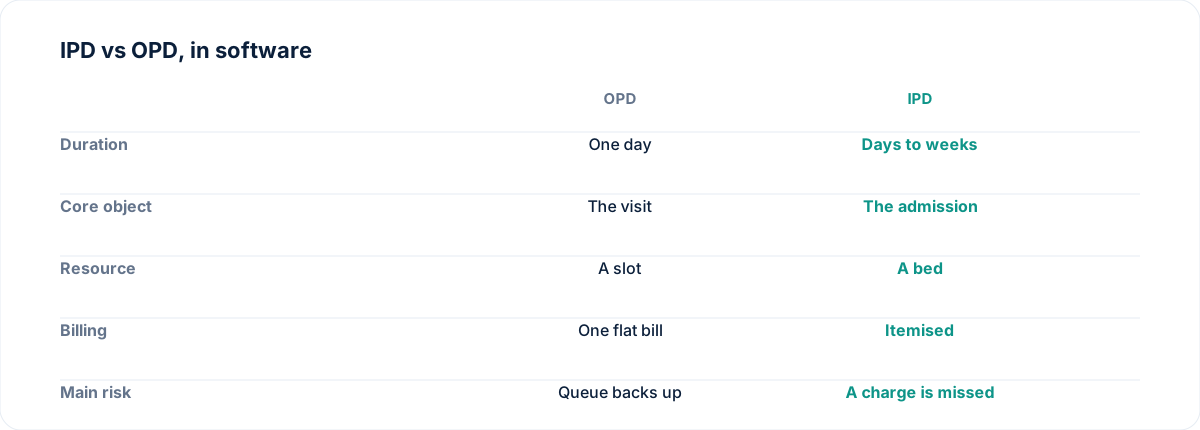
| | OPD | IPD | |---|---|---| | Duration | One visit, one day | Days to weeks | | Core object | The appointment / visit | The admission | | Physical resource | A slot | A bed (scarce, contested) | | Billing | One flat bill | Itemised — bed-days, procedures, consumables | | Clinical record | Consultation note | Vitals + progress notes + discharge summary | | Main risk | Queue backs up | A bed is wrong, a charge is missed |
The single most important object in IPD is the admission, and the single most important number is bed occupancy. If your software cannot tell you, instantly, how many ICU beds are free right now, it cannot run an inpatient ward — and an ICU at 100% is an emergency, not a statistic.
The bed-occupancy trap
Here is the mistake to watch for. Many systems store occupancy as a status on the bed that a clerk sets to "occupied" or "free". This creates two sources of truth: a bed can be marked occupied with no patient in it, or a discharged patient can leave a bed stuck occupied. The board slowly drifts away from reality until nobody trusts it.
The correct design derives occupancy from the live admission — a bed is occupied because an active admission points at it, full stop. The bed's own status then only carries what an admission cannot express: cleaning, maintenance, reserved, out of service. One source of truth, and the board can never silently lie.
What to require
Whatever system you evaluate, require that it handle both workflows as first-class citizens:
- OPD that keeps the queue fast.
- IPD with a real admission → bed/ward/room → transfer → vitals → progress notes → discharge lifecycle.
- A live bed-occupancy board derived from admissions, not hand-set flags.
- Itemised inpatient billing distinct from flat outpatient billing, in NPR, across self-pay, insurance and government schemes.
How CareSewa handles it
CareSewa's Hospital ERP models IPD and OPD as the two distinct workflows they are. Inpatient care runs the full admission lifecycle — wards, rooms, beds, transfers, nursing vitals, progress notes and discharge summaries — with a bed-occupancy board derived from live admissions, while outpatient visits keep their own fast path. Billing itemises an IPD stay by bed-days, procedures and consumables and settles it in NPR across every payer.
See it in context on the Hospital ERP page, or talk to us about your hospital's workflow.
Frequently asked questions
What is the difference between IPD and OPD in a hospital management system?
OPD (outpatient) is a visit: the patient arrives, is seen, is billed and leaves the same day. IPD (inpatient) is a stay: the patient is admitted to a bed, cared for over days, and only then discharged and billed. IPD software has to track beds, wards, admissions, transfers, nursing notes and a running bill that grows each day — none of which OPD needs. Treating them as the same 'visit' is where most software breaks.
Can one system run both IPD and OPD?
Yes, and it should. A patient often moves from OPD to admission and back, and their record and bill must follow them. CareSewa's Hospital ERP runs OPD visits and full IPD admissions on the same patient record, so an OPD consultation that becomes an admission does not start a new file or a new bill.
How does IPD billing work?
An IPD bill accumulates over the stay — bed charges per day, procedures, medicines dispensed, lab and diagnostic tests, and consultant fees — and is settled at discharge, often split across insurance/TPA, government scheme and self-pay. The system must keep this running total accurate in real time so discharge is not delayed by manual reconciliation.
How is bed occupancy tracked?
Reliable occupancy comes from live admissions, not from someone manually flipping a bed's status. In CareSewa, a bed's status reflects serviceability while actual occupancy is derived from current admissions — so the census is always honest even if a bed's housekeeping flag is stale.
See it on your own workflow
CareSewa runs ten healthcare ERPs on one no-code platform. Book a walkthrough for your hospital, clinic, pharmacy or lab.