No-Code Healthcare Software: Reshape Any Workflow Without a Developer
Healthcare software ages badly because every hospital is different and every request needs a developer. No-code changes that: define a model, get an API, and reshape a workflow in the browser. Here is what that means in practice.
Most healthcare software ages the same way. It is bought to fit a hospital on day one, and then the hospital changes — a new department, a new form, a new field the finance team needs — and every one of those changes is a support ticket, a quote, a release cycle. Two years later the software no longer fits, and nobody can afford to fix it. No-code is the answer to that decay: the people who run the hospital reshape the software themselves, in the browser, without waiting for a developer.
The problem no-code solves
Every hospital, clinic and lab is genuinely different. They admit differently, bill differently, and track things their neighbour does not. Traditional software handles this in one of two bad ways:
- Rigid product: everyone gets the same fields, and you bend your workflow to the software.
- Custom build: you get your workflow, at the cost of a developer for every change forever.
No-code is a third way: a configurable engine where the data models, forms and workflows are defined at runtime, not baked into code. You get software shaped to your hospital and the ability to keep reshaping it.
What "define a model" actually means
The core idea is simple. Instead of a developer writing a database table and an API and a form for every entity, you define the entity — its fields, their types, their validation — and the platform generates the rest:
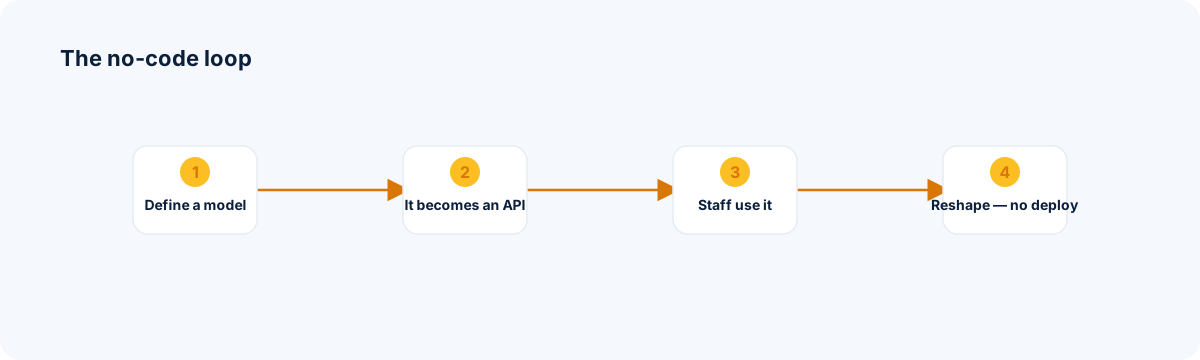
Add a field, and it appears in the form, the API and the list. Add a whole new record type — a referral, an asset, a consent — and it is a first-class part of the system in minutes, not a project.
Why this matters more in healthcare than anywhere else
Healthcare has the highest rate of "we need one more field" of any industry, because clinical practice, billing rules and regulation all keep moving. A discount reason the auditor now wants recorded. A new government scheme. A field a department invents to track something local. In rigid software each of these is a negotiation; in no-code each is a two-minute change made by the person who needed it.
Crucially, no-code does not mean no rules. A good healthcare engine keeps validation, permissions and audit at the platform level — so a non-developer can add a field, but they cannot break tenant isolation, bypass a permission, or lose the audit trail. Freedom to configure, inside guardrails that hold.
One API for everything you define
There is a quiet second benefit. When every model is defined the same way, every model gets the same REST API automatically. Your integrations — a lab machine, a payment gateway, a national health ID — talk to one consistent API surface, not a different bespoke endpoint per feature. For teams that want to build on top, that consistency is worth as much as the no-code itself. (See the developer view.)
What to check before you believe the "no-code" label
The term is oversold, so test it:
- Can I add a field to an existing record myself, and see it in the form and API immediately?
- Can I add a whole new record type without a developer?
- Are validation and permissions enforced no matter how I configure it?
- Is there an audit trail I cannot switch off?
- Does everything I define get a consistent API for free?
If the answer to those is yes, the software will still fit your hospital in three years. If it is no, you are buying something that starts decaying the day you install it.
Where CareSewa fits
CareSewa is built on exactly this kind of engine. Every one of the ten ERPs — hospital, clinic, lab, pharmacy and the rest — is defined on the same no-code platform, and CareSewa Studio lets your own team reshape any workflow in the browser. That is why adding a field, or a whole record type, is something you do yourself, in minutes.
Talk to us about your workflow, or explore the platform.
Frequently asked questions
What is no-code healthcare software?
No-code healthcare software is built on a configurable engine where data models, forms and workflows are defined at runtime rather than baked into code. The people who run the hospital can add a field, a form or a whole record type themselves, in the browser, without waiting for a developer. It is the difference between software that keeps fitting your hospital and software that starts decaying the day you install it.
Does no-code mean there are no rules or validation?
No. A good healthcare engine keeps validation, permissions and audit at the platform level. A non-developer can add a field, but they cannot break tenant isolation, bypass a permission or switch off the audit trail. It is freedom to configure inside guardrails that always hold.
Can I add a new field or record type without a developer?
That is the whole test of a real no-code platform. In CareSewa, adding a field makes it appear in the form, the list and the API immediately, and adding a whole new record type is a matter of minutes, not a release cycle. Every model you define also gets the same consistent REST API for free.
Is no-code suitable for a large hospital?
Yes — arguably more so, because large hospitals have the highest rate of 'we need one more field' as departments, billing rules and regulations change. No-code turns each of those from a support ticket into a two-minute change made by the person who needed it, while the platform keeps enforcing the rules.
See it on your own workflow
CareSewa runs ten healthcare ERPs on one no-code platform. Book a walkthrough for your hospital, clinic, pharmacy or lab.